Shubham Jangid

I makeheavy appsfeel light.

Shubham Jangid, frontend engineer. Six years on React and Electron products — a real-money poker client, a dealership platform, a digital signing system — mostly spent on the parts people only notice when they are slow.

Based in
New Delhi, India
Shipping since
2020
Currently
SDE-III, Baazi Games
Open to
Senior frontend roles

This page showed its first content in—ms

scroll

01,800 ms — where Google stops calling it fast

How I work

Three habits that survived four companies.

Speed

Most of my work starts with a profile, not a rewrite. I measure first, keep the number, and change the smallest thing that moves it. The 1.4 seconds I took off page load at Tekion came from caching, lazy loading and render discipline — nothing was thrown away.
Structure

I lean on design patterns hard enough that shipping stops being risky. Reusable higher-order components, custom hooks, micro-frontends over module federation. The point is that the next engineer can ship a feature without reading the whole codebase first.

People

I review pull requests, run solution discussions, and mentor the engineers around me. Almost everything I know about frontend arrived because someone senior took the time to do this for me, so I try to keep the debt moving.

What changed

Numbers I kept, from work that shipped.

1.4s

cut from page load at Tekion, through data caching, lazy loading and cheaper renders.

54%

module test coverage on the digital signing platform, up from 18% in a year.

60%

fewer upgrade failures at Baazi Games after reworking how releases reach the desktop client.

34%

faster loads on an NFT marketplace front end at Zeeve, with MetaMask in the critical path.

Products

Three products I designed, built and run on my own. Two are live; Kharcha is in closed beta on Android.

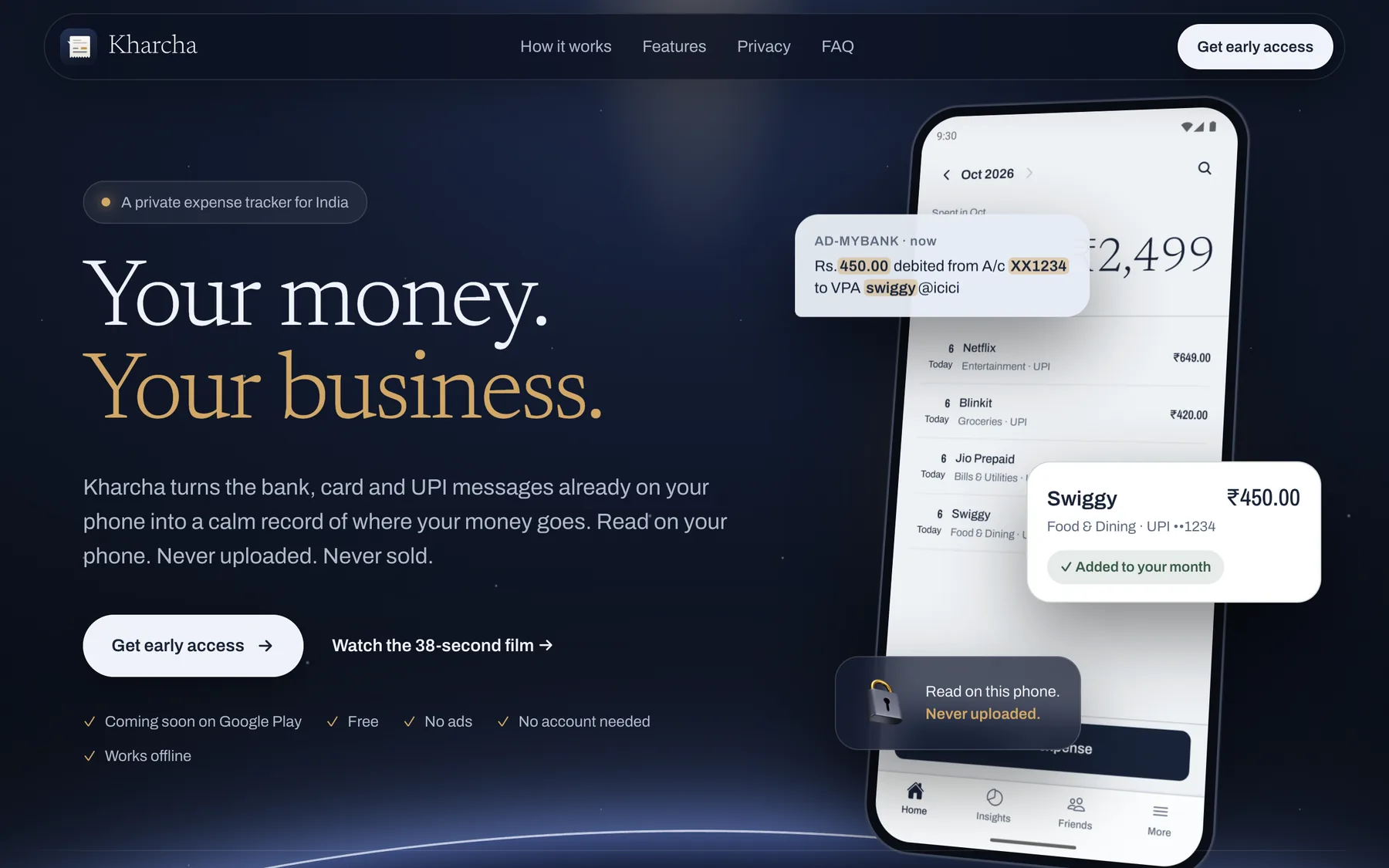
Kharcha home page on desktop
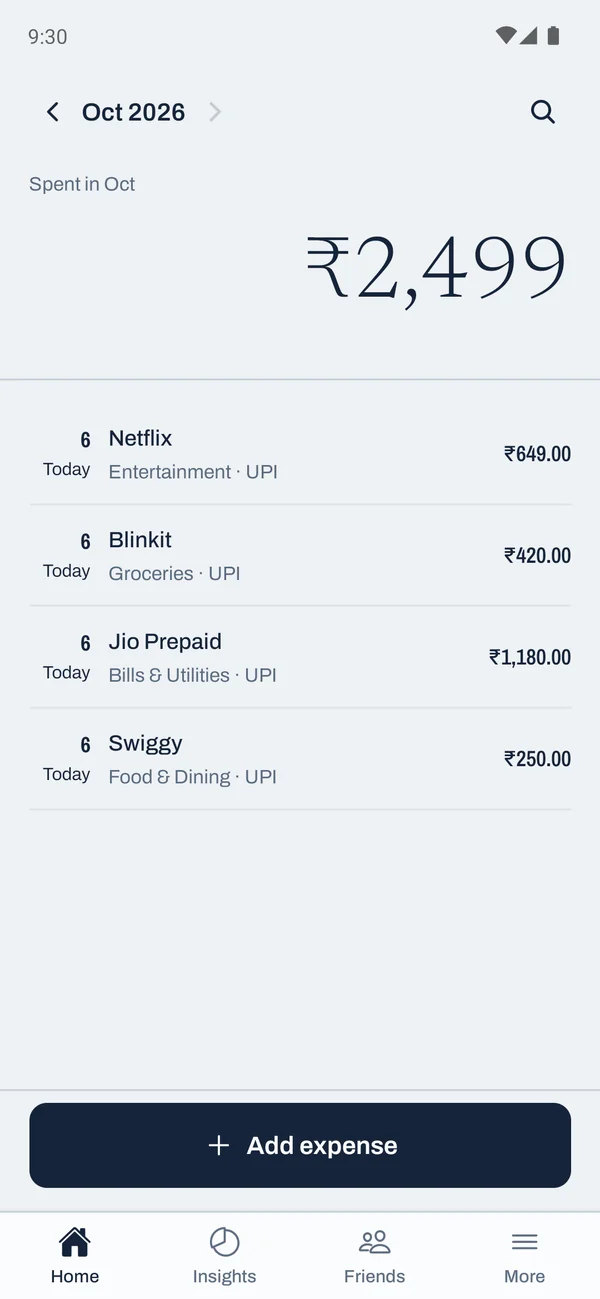
Kharcha app home screen, showing the month's spending
01Android expense trackerClosed beta · Android

Kharcha

Your bank SMS become expenses, and never leave the phone.

A private expense tracker for India. It reads the bank, card and UPI alerts already on your phone and turns them into a record of where the money went, without an account, without the internet, and without the loan calls that follow most money apps. I designed, built and run it on my own.

Under the hood

  • Bank alerts are parsed on the phone by rules I wrote (amount, merchant, card digits and date), with one-time passwords masked. No server or AI service ever sees a message.
  • Offline-first on SQLite. The optional backup goes to Firestore in Delhi, with merchant names, notes and friends' names encrypted with AES-256 under a key from your password.
  • Card spends grouped into bill cycles with refunds netted off, money lent and borrowed with friends, and a website that counts visitors without cookies or JavaScript.
Stack
React Native, Expo SDK 56, TypeScript, SQLite
Runs on
Android, on the device; site on Cloudflare Workers
Since
May 2026
Visit kharcha.shubhamjangid.in
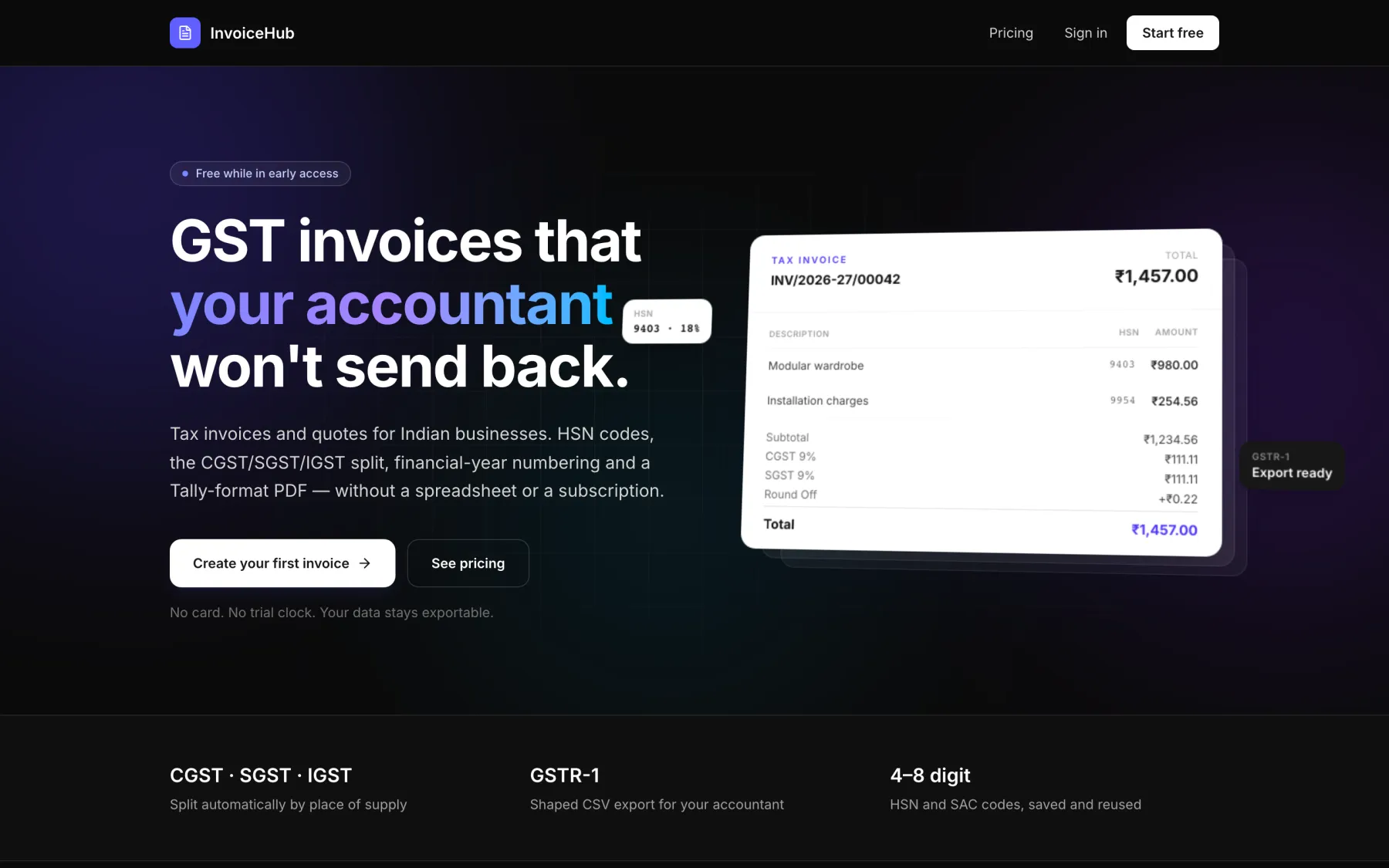
InvoiceHub home page on desktop
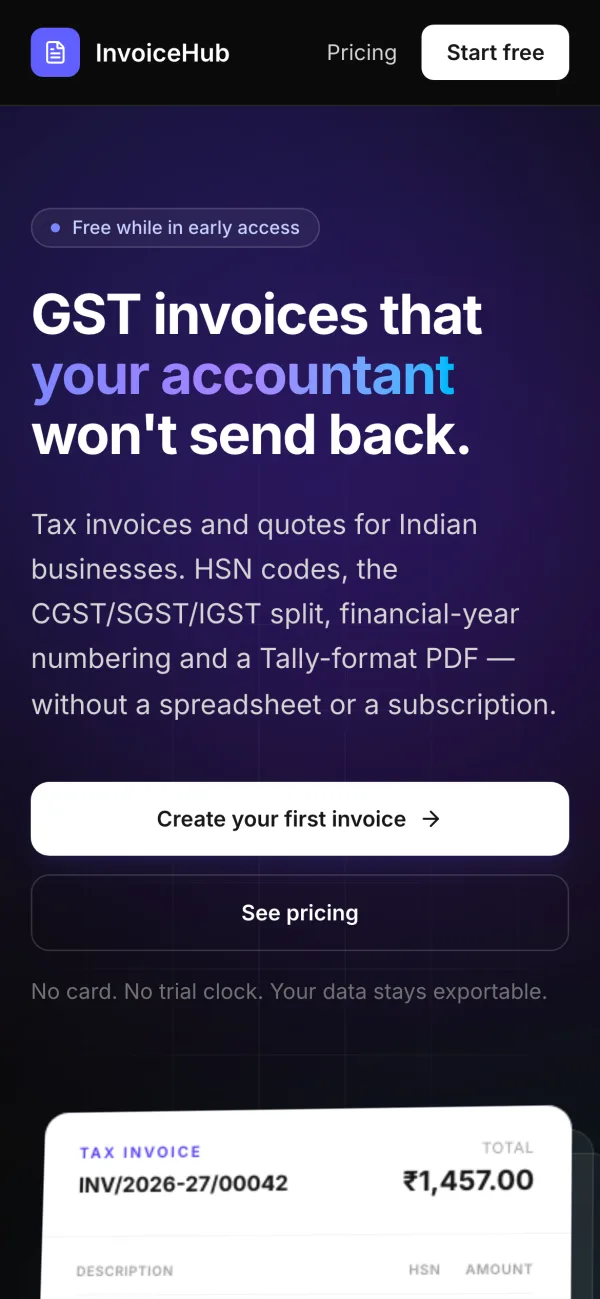
InvoiceHub home page on a phone
02GST invoicingLive · early access

InvoiceHub

GST invoices that your accountant won't send back.

Tax invoices and quotes for small Indian businesses that raise a handful of invoices a month and need every one to be right. I designed, built and run it on my own.

Under the hood

  • CGST, SGST or IGST decided by place of supply, rounded to the rupee in the data, not just on the PDF.
  • A Tally-format PDF with HSN per line, amount in words and a UPI QR code, plus a CSV shaped for GSTR-1.
  • Nothing is ever deleted: invoices are cancelled, every change is audited, and a nightly off-site backup has a watchdog.
Stack
Next.js 16, TypeScript, Prisma, Postgres
Runs on
Vercel + Neon, colocated in Singapore
Since
March 2026
Visit invoicehub.shubhamjangid.in
Eagle Decor website

Running on it

Eagle Decor

An interior design studio in Gurugram raises its GST invoices and quotes on InvoiceHub.

eagledecor.in
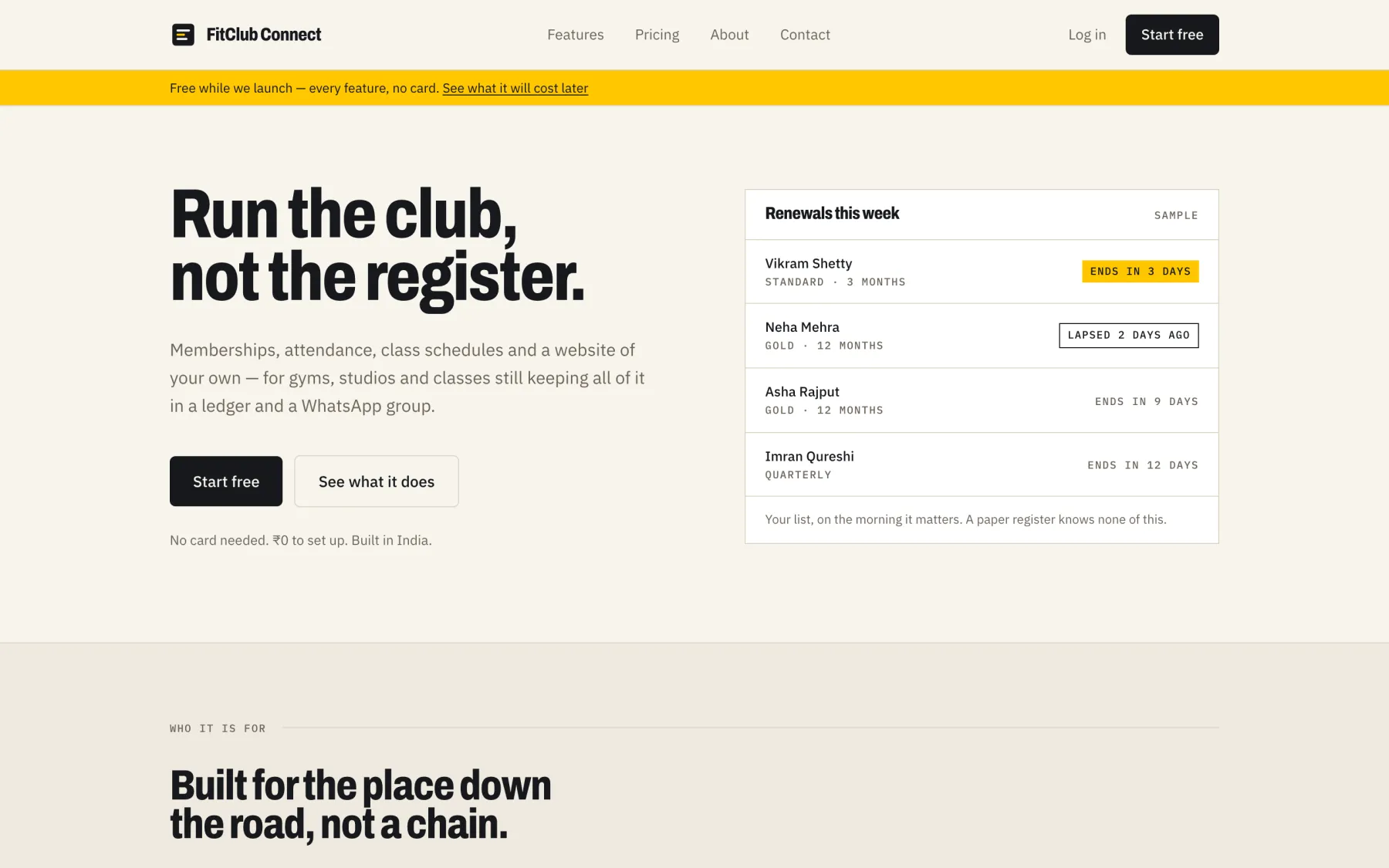
FitClub Connect home page on desktop
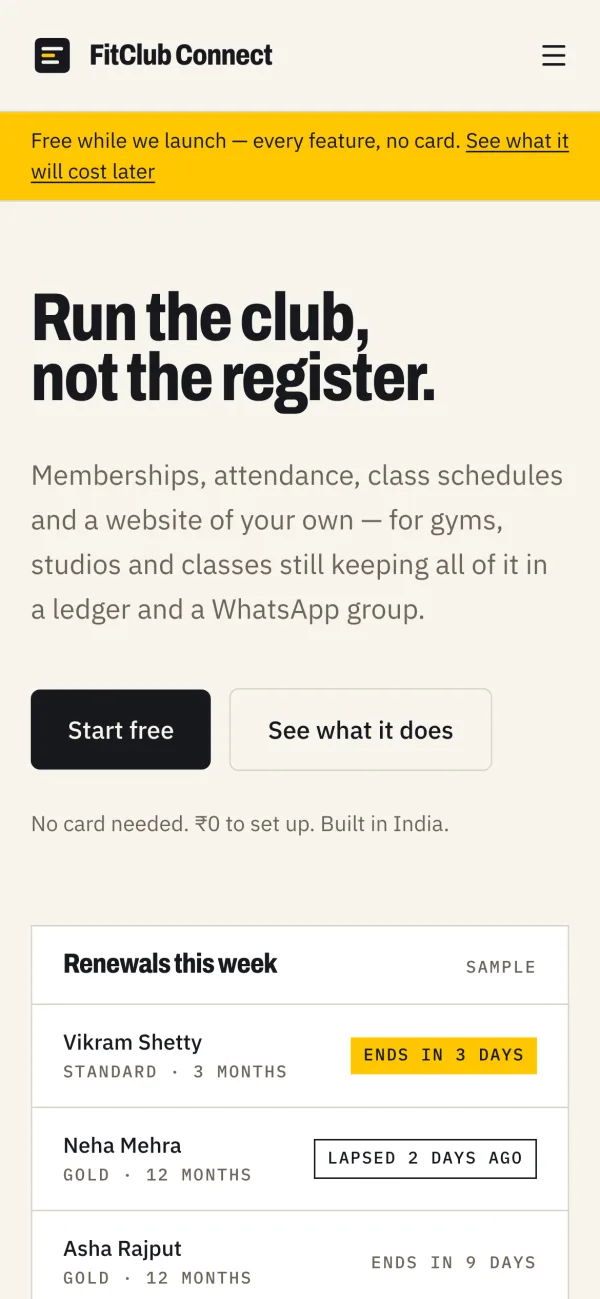
FitClub Connect home page on a phone
03Gym & studio softwareLive · free while launching

FitClub Connect

Run the club, not the register.

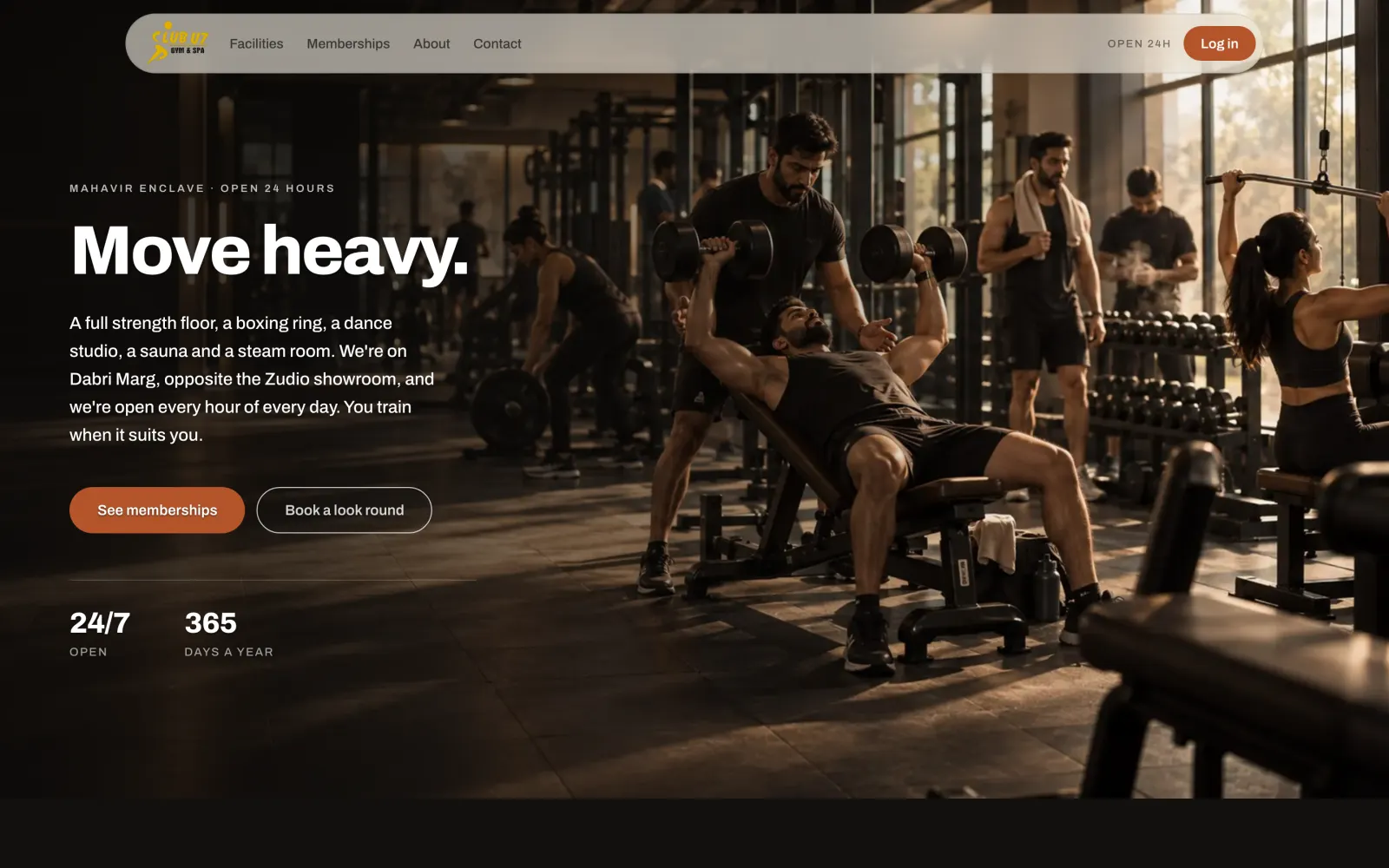
Memberships, attendance, schedules and a website of their own, for gyms and studios still running on a paper ledger and a WhatsApp group. Every club gets its own themed site, on its own domain.

Under the hood

  • Multi-tenant from the Host header: one deploy serves the platform, every club subdomain and custom domains with TLS.
  • Seven roles, checked on the server for every action, with Firestore rules scoped to the tenant.
  • Members sign in with just a phone number. Renewal reminders go out on WhatsApp from a daily edge cron.
Stack
Next.js 16, React 19, Firestore
Runs on
Cloud Run behind a Cloudflare Worker
Since
July 2025
Visit fitclubconnect.in
Club U7 website, built on FitClub Connect

Running on it

Club U7

A 24-hour gym in Delhi runs its public site, memberships and member logins on FitClub Connect.

clubu7.com

Where

2020 to now, in order.

2024 — now

Baazi Games

Real-money poker on a React and Electron desktop client: PokerBaazi in India, then the global CoinPoker platform after India's 2025 real-money gaming ban.

Promoted to SDE-III after twelve months.

SDE-III

Apr 2025 — now
  • Built, with Claude Code, an automation platform that tests the desktop app around the clock on Windows and macOS: 60+ test cases on real gameplay, with an AI agent that checks every report and fixes or files what it finds.
  • Hardened the Electron client across 300+ files and 35+ windows: preload bridge, locked-down IPC, CSP and security fuses.
  • Built a Claude-powered pull request review step in CI, and lead the final reviews and solution discussions for an 11-engineer team.
  • Cut app launch time from about 3 seconds to about 2.

SDE-II

Apr 2024 — Apr 2025
  • Put design patterns into production rather than slide decks, which made features cheaper to add and safer to change.
  • Shipped 12+ PokerBaazi features on time with no production bugs, from Bomb Pot and Run It Twice to a lobby revamp, and cut upgrade failures by over 60%.
  • Built an in-app network latency and lag monitor so player connection problems could be diagnosed instead of guessed at.

2022 — 2024

Tekion

Cloud software for car dealerships. I owned the digital signing product.

Promoted to SDE-2 after twelve months.

SDE-2

Mar 2023 — Mar 2024
  • Rewrote the digital signing application as a scalable platform built on reusable higher-order components and custom hooks.
  • Added authentication and moved the front end to a micro-frontend architecture using module federation.
  • Took module test coverage from 18% to 54% and built the internal tools the team used daily.

SDE-1

Mar 2022 — Mar 2023
  • Built the shared component and hook layer other teams composed their screens from.
  • Wired real-time notifications through Pusher and shipped dynamic theming across platforms.
  • Reduced page load time by 1.4 seconds with caching, lazy loading and render work.

2021 — 2022

Zeeve

Blockchain infrastructure. I worked on the marketplace front end.

Frontend Engineer

Aug 2021 — Mar 2022
  • Built and tuned an NFT marketplace front end with MetaMask integration, cutting page load time by 34%.
  • Refactored the transaction flow so new features stopped costing a week each.

2020 — 2021

Tata Consultancy Services

On the team that built Israel's first fully digital bank.

System Engineer

Jul 2020 — Aug 2021
  • Built services and the customer onboarding interface for the bank.
  • Wrote Spring batch jobs for end-of-day customer messaging.
  • Built components and screens for the back office application, and modernised older ones.

2016 — 2020

B.Tech, Information Technology

Ch. Brahm Prakash Government Engineering College, Delhi

Tools

What I reach for without thinking.

Building

  • React
  • Next.js
  • Electron
  • TypeScript
  • JavaScript
  • Redux

Shaping

  • CSS
  • SCSS
  • HTML
  • Material Design
  • Design systems

Tooling

  • Webpack
  • Module federation
  • Git
  • Jest
  • Performance profiling

Open to senior frontend roles

Tell me what you’re building.

A role, a stubborn performance problem, or a second opinion on an architecture — all fine. I read everything that arrives here.